Formation
Le maître-chien et son compagnon doivent suivre une formation exigeante afin de pouvoir faire face efficacement aux situations qui leur seront confiées.
Au Québec, aucun corps de police ne fait former ses chiens par des institutions privées : la formation est toujours donnée par un corps de police de la province ou du Canada.
Formation du maître-chien
Chacun des maîtres-chiens de l'unité doit remplir les exigences suivantes :
- Posséder au moins une attestation niveau II en élevage/éducation canine, décernée parla Certification Cyno-ProfessionnelleCanadienne Itée
- Avoir un minimum de 4 ans d’ancienneté au Service de police dela Villede Montréal (SPVM)
- Avoir réussi toutes les étapes du processus de sélection ainsi que le programme de formation
Formation du chien
Tous les chiens policiers du SPVM sont formés parla Sectionformation de l’unité canine du SPVM. Cette formation se déroule en 2 grandes étapes : d’abord en famille d’accueil, puis avec le maître-chien.
Formation en famille d’accueil
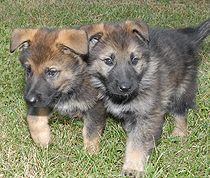
Les chiens commencent leur formation dès leur arrivée au Service, alors que, âgés de 8 à 10 semaines, ils sont placés dans une famille d’accueil membre du SPVM.
Ces familles d’accueil auront, par le jeu, à développer le potentiel du chiot en le socialisant et en le familiarisant avec les différents environnements :
- bruit
- escalier
- surface glissante
- endroit sombre
- etc.
Vers l’âge de 8 mois, les chiens doivent passer des tests afin que soit évalué leur potentiel :
- Évaluation de l’instinct de prédation, de jeu et de combativité
- Évaluation de la familiarisation et de la socialisation
Les chiens retenus à cette étape retourneront dans leur famille d’accueil respective pour prendre de la maturité.
Formation avec le maître-chien
Vers l’âge de 2 ans, le chien sera assigné à son nouveau maître pour commencer sa vraie formation de chien de police.
La formation complète d'un chien de gendarmerie est d’une durée moyenne de 105 jours de formation.
Au cours de sa rigoureuse formation, le chien sera entraîné graduellement pour atteindre les standards requis dans chacune des disciplines, soit :
- Dépistage
- Recherche extérieure (toutes les formes)
- Recherche en bâtiment
- Détection
- Obéissance
- Désensibilisation aux coups de feu
- Agilité
- Protection et appréhension de suspects
Formation de l’équipe cynophile
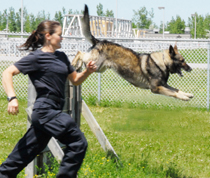
Lorsque le chien policier est opérationnel, il doit participer, avec son maître, à tous les programmes de perfectionnement requis par l’exercice de ses spécialités.
L’équipe doit également effectuer un programme d’entraînement quotidien nécessaire au maintien de la performance, et ce, tout au long de la carrière du chien.
L’équipe cynophile devra aussi se qualifier à une validation annuelle pour chacune des disciplines pour lesquelles elle a été entraînée.
Histoire
Une première unité canine a vu le jour à Montréal vers le milieu des années 60. À ses débuts, l’unité était constituée de 5 agents et de leur partenaire canin.
L’unité ne servait que rarement à des opérations policières, se consacrant davantage à des missions de relations publiques. La direction de l’époque avait donc décidé d’abolir l’unité, pour des raisons administratives, en 1972.
Projet-pilote en 1995
C’est en 1995, 23 ans après la disparition de l’unité canine, que l’utilisation des chiens réapparaît sous forme d’un projet-pilote qui s’avère un vif succès.
Aujourd’hui
L’unité canine est devenue permanente, au sein du Service de police, en 1996.
Chaque équipe cynophile participe annuellement, en moyenne, à 300 interventions de tous genres (dépistage, recherches extérieures, protection, appréhension de suspects, etc.) où elle utilise les compétences acquises dans ses disciplines de formation. À ces nombreuses interventions s’ajoutent l’enquête de routine, les patrouilles dans les métros, les parcs et les commerces, les visites d’écoles et des endroits cibles, etc. Bref, les équipes cynophiles sont toujours très actives!
Saviez vous que…
- On évalue que l’odorat d’un chien est de 10 000 à 20 000 fois supérieur à celui de l’homme.
- Tous les chiens opérationnels du SPVM habitent chez leur maître.
- Pour 1 heure de recherche extérieure faite par un chien policier, il faudrait 30 policiers pour accomplir autant.
- Les chiens sont insensibles au poivre de Cayenne et aux gaz chimiques employés par les services de police.
- Les équipes cynophiles du SPVM ont comme secteur de patrouille toute l’île de Montréal.
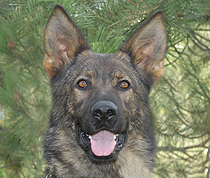
The dog and handler have to undergo rigorous training to learn how to effectively deal with the situations they may have to confront.
In Québec, no police force has its dogs trained by private institutions: the training is always given by a police force either in the province or elsewhere in Canada.
Handler training
Each of the dog handlers in the unit must fulfil the following requirements:
- Have at least level II certification in dog raising/training from Certification Cyno-Professionnelle Canadienne Itée
- Have at least 4 years of seniority at the Service de police dela Villede Montréal (SPVM)
- Have passed every step in the selection process and training program
- Be a member of the Association des maîtres de chiens policiers du Québec and the Canadian Police Canine Association.
Dog training
All of the SPVM police dogs are trained by the SPVM’s Section formation de l’unité canine du SPVM. The training includes two major segments, first in a foster family and then with the dog handler.
Training in the foster family
The dogs begin their training as soon as they enter the Service when, at the age of 8 to 10 weeks, they are fostered to the family of an SPVM member.
These foster families are asked to develop the dog’s potential through play, socializing them and teaching them about different environments:
- noises
- stairs
- slippery surfaces
- dark places
- etc.
Around the age of 8 months, the dogs are tested to evaluate their potential:
- Evaluation of instinct for predation, play and combativeness
- Evaluation of familiarization and socialization
- Courage test
The dogs retained at this stage return to their respective foster families to gain maturity.
Training with the dog handler
Around the age of one-and-a-half, the dog is assigned to its new handler to begin its real training as a police dog.
The basic training for a general purpose dog last about 18 weeks. To this is added 5 weeks of specialization training, for detection of narcotics, firearms or explosives.
During the rigorous training, the dog is gradually taught to achieve the standards required in each of the disciplines:
- tracking
- outdoor search (all types)
- indoor search
- detection
- obedience
- desensitization to gunfire
- agility
- protection and apprehension of suspects
- desensitization to chemical gases
Team training
When the police dog is operational, it must participate with its handler in all the professional development programs required for the execution of its specialty.
Throughout the dog’s career, the team also carries out a daily training program to keep its skills and performance levels up to par.
The dog team must also undergo an annual assessment in each of the disciplines it has trained for.
History
Montréal’s first canine unit was formed in the mid-1960s. In the early days, the unit consisted of five officers, each with their own canine partner.
The unit was used only rarely in police operations and spent more time working in public relations. The executive decided to abolish the unit for administrative reasons in 1972.
Pilot project in 1995
In 1995, 23 years after the canine unit was disbanded, dogs again joined the SPVM as part of a pilot project which quickly proved successful.
Today
The Escouade canine was made a permanent part of the Service de police in 1996.
Each dog team participates every year in an average of 300 police interventions of various types (tracking, outdoor searches, indoor searches, protection, apprehension of suspects, and so on), using the competencies acquired in its specific areas of training. In addition to these special operations, the teams do routine investigations, patrol metros, parks and businesses, visit schools and other target places and more. In short, the dog teams are very busy!
Police dog trivia …
- A dog’s sense of smell is estimated to be 10,000 to 20,000 times more sensitive than a human’s.
- All the SPVM’s operational dogs live with their handlers.
- To replace one hour of outdoor search by a police dog you would need 30 police officers.
- The dogs are not affected by the cayenne pepper and chemical gases used by police forces.
- The SPVM’s dog teams patrol the entireislandofMontréal.
Services offered
Complete dog team training
- Training offered to police forces, with the exception of certain private security agencies, provincial and federal organizations.
- Instructors recognized by the École nationale de police du Québec (ENPQ) and the Association des maîtres de chiens policiers du Québec
- High level of technical expertise
Explosive detection service
- Service offered to police forces and private organizations (booking agencies, community groups, airports)
- Recognized instructors
- High level of technical expertise
Demonstrations (agility, protection, detection) and information booths
- Service offered to police forces, private organizations and exhibit organizers
- High level of technical expertise
For more information, please contact the Service de police de la Villede Montréal Commercial Services team.