
Highlights
25 years of 911
1985
On December 1, the Communauté urbaine de Montréal (CUM) inaugurated the 911 Emergency Centre, which began receiving all emergency calls within the CUM territory, analysing them and transferring them to the appropriate responders.
The centre also handled all calls for the Communauté urbaine de Montréal police service (SPCUM).
1987
On July 14, a torrential downpour struck Montréal. The rain followed a heat wave that had lasted several days. That afternoon, lines of storm clouds formed to the west of the city and moved toward Montréal, inundating the centre of the island with more than 100 millimetres of rain in just two hours.
1989
 The arrival of digital technology in CUM police cars allowed officers to receive complete call data.
In December of that same year, there was a serious tragedy in Montréal. Toward the end of the afternoon of December 6, 1989, calls began flooding into the 911 Emergency Centre to report a shooter inside the École Polytechnique.
1992
On August 24, Concordia University was the target of another lone gunman. Professor Valery Fabrikant went to the ninth floor of the Henry F. Hall Building and fatally shot of his three colleagues. A fourth person was wounded and died a month later. A woman was also wounded in the incident, but survived.
1993
On June 9, the Montréal Canadiens hockey team won the Stanley Cup against the Los Angeles Kings. The jubilant fans invaded downtown and a riot erupted, causing thousands of dollars of damage.

1995
Following a decision by the Canadian Radio-television and Telecommunications
In June of the same year, the funding formula for the 911 service was switched from tax bills to a monthly charge of $0.40 per phone line. Commission (CRTC), Bell Canada began to work on the design and implementation of the 911 Public Emergency Reports System (911 PERS), a brand new system that would provide safer and more effective 911 services for Québec and Ontario.
In November, for the first time in its history, the 911 staff had to evacuate headquarters when a fire broke out in a neighbouring building early in the evening. The heat from the inferno was so intense that the electronic equipment near the windows in the 911 building began to melt and smoke poured into the corridors.
The evacuation was carried out in two phases, with a first group of dispatchers leaving the building and heading to the backup centre in the cavalry headquarters on Mount Royal, to take calls from there. As soon as they were in position, the group who had remained behind left the building and headed for Mount Royal as well.
Despite the difficult circumstances, the operation went very smoothly.
1996
The CUM Commission de la sécurité publique decided to review the mission of the 911 Emergency Centre, which included handling calls for the police service.
The Commission gave the SPCUM the mandate to process its own calls starting in fall 1997, making the police service an emergency responder like the others.
In February, Bell rolled out the PERS network.
1997
On December 15, 911 stopped analysing and processing police calls and transferred all police call operations to the SPCUM.
1998
 From January 5 to 16, 1998, much of the province was paralysed by a major ice storm. At the 911 centre in Montréal, the dispatchers answered 72,690 calls, 80% more than in the same period in 1997.
Management’s post-event analysis led to the recommendation that a backup centre should be established. A year later the new backup centre was operational and ready to handle calls in the event of fire or equipment breakdown at the main centre.
Both call centres can operate in tandem, as was demonstrated on New Year’s Eve 2000, to double the centre’s answer capacity.
1999
On April 1, the CUM officially opened the backup centre, to handle emergency calls in the event of a failure of the 911 Centre.
On the night of December 31, the 911 Emergency Centre, like all other municipal services, was on emergency standby in preparation for the infamous Y2K changeover.
2002
After the municipal mergers, the SPCUM became the Service de police de la Ville de Montréal (SPVM).
2006
On September 13, gunman Kimver Gill entered Dawson College and fired on the students in the building, fatally wounding Anastasia De Sousa. 911 received 609 calls in less than 90 minutes, an increase of 176% over normal.
2008
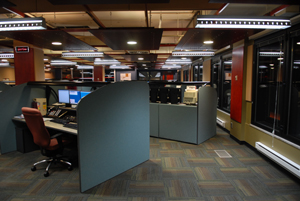
On October 19, the 911 Emergency Centre and the SPVM’s call handling division merged their services again. 911 dispatchers now handle emergency calls to the SPVM.
2010
In February, the geographic coordinates (longitude, latitude) of cell phone callers became available for 911 dispatchers.